
Hiring a Production Crew in Denmark as a Foreign Brand
If you are a brand or agency outside Denmark planning a shoot here, the hard part is not finding a camera operator. It is working out who signs what, who invoices whom, and how long the paperwork takes.
We produce for foreign brands, agencies and production companies in Copenhagen most months of the year — UK production companies who need a Danish crew, Stockholm agencies running a Danish campaign, US companies filming a European event. This is the practical version of what that involves: crew structure, what things cost, how VAT works, and the timeline you should actually plan to.
Three ways to shoot in Denmark, and what each one costs you
Before rates, decide the structure. It changes everything downstream.
1. Fly your own crew in
You keep your people and your look. You also pay flights, accommodation, per diems and travel days for everyone, and you carry equipment across a border. Within the EU that is straightforward; from the UK or US it means a carnet for serious kit, and customs can take an interest.
The real problem is the public realm. A foreign company cannot submit a Copenhagen filming permit application — the city’s portal requires MitID, Denmark’s digital identification, and the form asks for a Danish CVR and P-number. If any part of your shoot touches a street, a square or a park, you need a Danish entity to hold the permit regardless of whose crew is on camera. We covered that in detail in our guide to filming in Copenhagen.
Makes sense when: the creative depends on a specific director or DOP, the shoot is entirely inside a private venue, and the budget absorbs travel for four or more people.
2. Hire individual Danish operators directly
Cheapest on paper. You source a camera operator, a sound recordist and an editor separately, and manage them yourself from another country.
What this costs you is coordination and risk. Three separate contracts, three insurance positions, three invoices in three formats, and nobody on the ground whose job is to make the day work. If someone cancels the week of the shoot, you are recruiting from abroad with no network. And you still cannot pull a permit.
Makes sense when: it is a single interview in an office, one person with a camera, and you have shot in Denmark before.
3. Appoint a Danish production partner
One Danish company contracts with you, fields the crew, holds the permits, carries the insurance and sends one invoice. You brief one party and they absorb the local complexity.
The honest trade-off is that a production partner is not the cheapest line on a spreadsheet, because coordination is real work and it is priced. What you get back is a single point of accountability and someone who has already filmed at the venue you are about to use.
Makes sense when: the shoot touches public space, runs more than one day, needs more than two people, or has a fixed delivery date you cannot miss.
What a Danish crew actually looks like
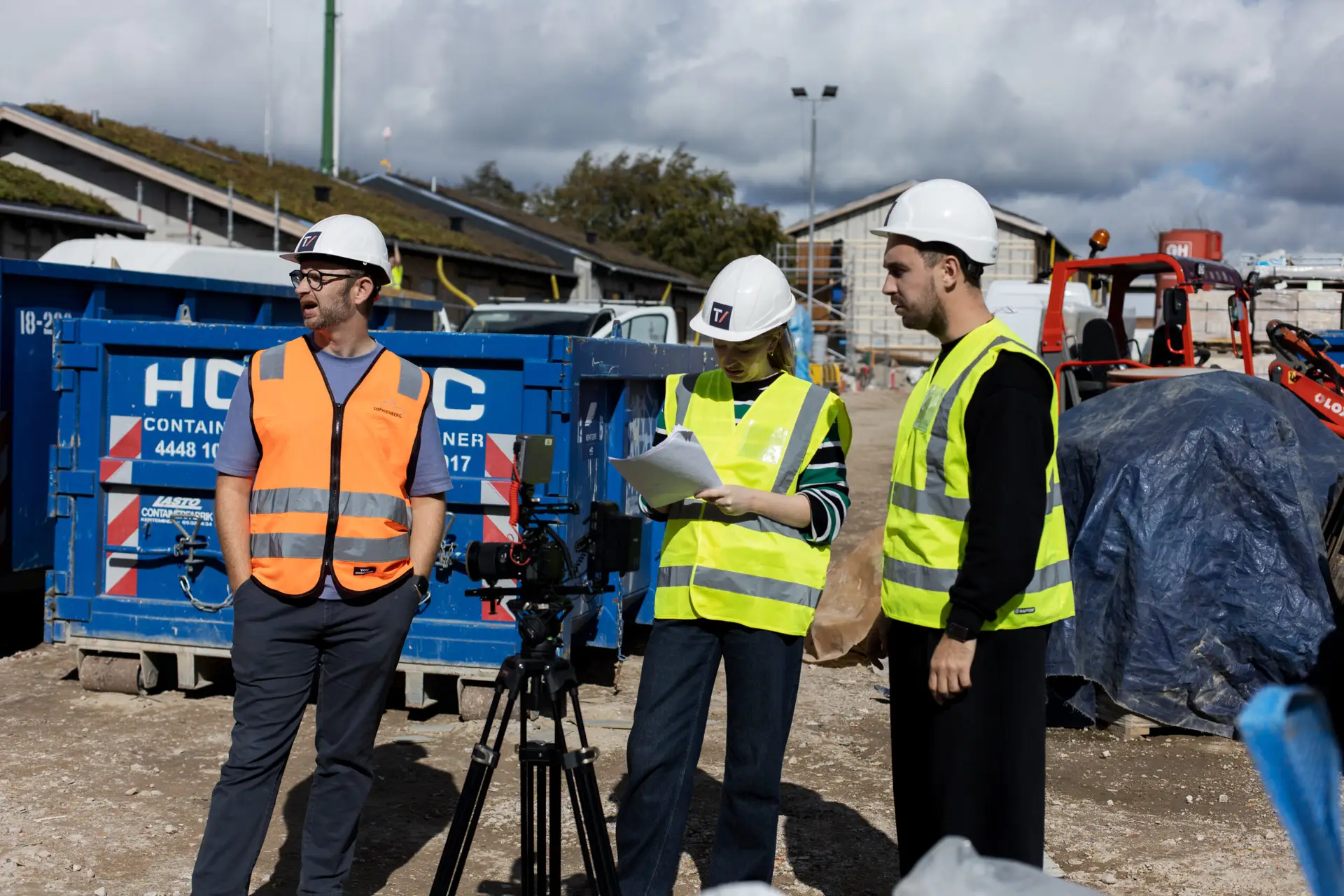
Danish crews run leaner than UK or US equivalents for the same output. A corporate interview day that would carry six people in London is commonly three or four here, and the work still gets done — partly because operators are used to covering more than one role, partly because the market is smaller and specialisation is less rigid.
- Director / producer — runs the day, manages the client, makes the call when the schedule slips
- DOP or camera operator — on a corporate or event shoot these are often the same person
- Second operator — added for multi-camera interviews, stage coverage or anything you only get one take at
- Sound recordist — essential for interviews and panels; on a run-and-gun social shoot the operator usually handles audio
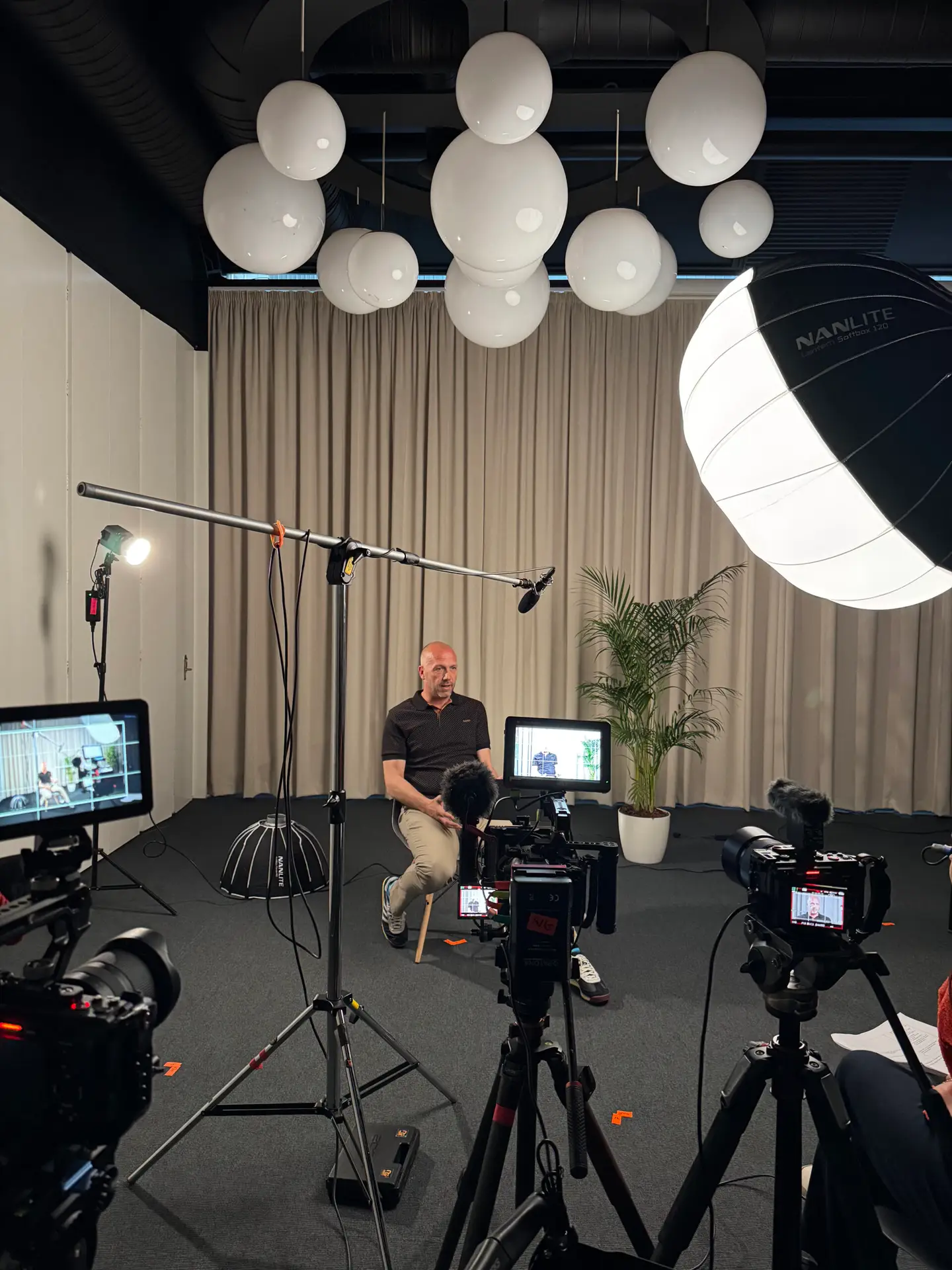
- Gaffer / lighting — booked for controlled interviews and commercials, rarely for event coverage
- Camera assistant — lighting and audio support, kit management; the difference between a smooth day and a rushed one
- Drone operator — must hold EU certification and the right category for the flight; aerial work over a Danish city is planned weeks ahead, not added on the day
- Editor — usually priced per deliverable rather than per day
Ask any Danish partner you approach who specifically is on the day. A good answer names people and what they have shot. A vague answer about “our network” means they are recruiting after you sign.

How Danish production is priced
Most Danish production companies, ourselves included, quote a fixed project fee rather than billing hourly. The fee is built from day rates, but what you sign is a number for the whole job.
A shoot day is normally 10 hours including setup and wrap, not 10 hours of rolling. Half days exist but rarely save half the money, because the kit still has to be packed, moved and set up.
What moves the number, roughly in order of impact:
- Number of shoot days — and whether they are consecutive, since a gap day still blocks the crew’s calendar
- Crew size — the single biggest lever, and the one most worth interrogating in a quote
- Deliverables — a hero film is one number; a hero film plus eight social cutdowns plus subtitled versions in three languages is a different project
- Number of locations — company moves eat hours, and on public ground each location is a separate permit application
- Turnaround — same-day or next-morning delivery changes how the days are crewed, because someone is editing while someone else is still shooting
- Specialist kit — drone, gimbal, multi-camera stage recording, teleprompter, additional lighting
- Time of year — in December Copenhagen gives you around seven hours of daylight, so winter exteriors need more lighting and a tighter schedule than the same shoot in June
Two things to check in any Danish quote: whether equipment is included or hired on top, and whether travel days are charged. For a shoot in Aarhus or Odense, a Copenhagen crew’s travel time usually appears somewhere. Better it is in the quote than on the final invoice.

VAT and invoicing: the part that delays payment
Danish VAT — moms — is 25%. Whether it lands on your invoice depends on where your company is and whether it is VAT-registered.
EU business clients
For business-to-business services within the EU, the reverse charge mechanism normally applies. The Danish supplier invoices without Danish VAT and you account for it in your own country. For that to work you must give your valid EU VAT number before the invoice is raised, and the invoice should state that the reverse charge applies.
The practical failure here is boring and common: the VAT number arrives after invoicing, the invoice has to be credited and reissued, and payment slips by a fortnight. Send it with the booking.
UK, US and other non-EU business clients
Production services supplied to a business customer outside the EU generally fall outside the scope of Danish VAT under place-of-supply rules, so the invoice is typically issued without it. Your own domestic rules then determine what, if anything, you account for at home.
Everyone else
If you are a Danish company, a private individual, or a business without a valid VAT registration, 25% Danish VAT applies.
Two more practical points. Any legitimate Danish supplier has a CVR number and it appears on their invoice — if it does not, ask why. And payment terms here are commonly 8 to 30 days, with larger productions often split into a deposit on booking and the balance on delivery.
This is how it works in practice on the productions we run, not tax advice. VAT treatment depends on your specific circumstances — confirm the position with your own accountant before you budget around it.
The timeline you should actually plan to
Denmark is quick compared with most of Europe. The constraint is rarely crew availability — it is permits and the calendar.
- Single interview, private location: 48 hours is realistic, same-day is sometimes possible
- Event or conference coverage: one to two weeks is comfortable; we take late bookings but the venue walk-through suffers
- Multi-day production, private venues: two to three weeks
- Anything filming on public streets or in parks: six to eight weeks. The city quotes around 10 working days for a straightforward road-area application and up to 20 when other parties must be consulted, it is one application per location, and residents should be notified about a week before.
- Drone work in central Copenhagen: plan weeks ahead. It needs aviation compliance and a separate municipal permit.
One Danish-specific thing worth knowing: July is quiet. Much of the country takes three weeks’ holiday from late June, crew availability thins, and venues run reduced staff. Plan a July shoot earlier than you would in another market.
Contracts, insurance and the things that go wrong
Ask for these before you sign. Any established Danish production company will have all three to hand.
- Business liability insurance. Many Danish venues ask for proof before they let a crew in. Get the certificate early rather than on the morning.
- A service agreement that names the deliverables. Formats, aspect ratios, number of revision rounds, delivery dates. Most disputes in this industry are about scope, not quality.
- Written rights and usage terms. Who owns the footage, where the film may run, for how long, and whether raw material is handed over. Agree it before the shoot, not during the edit.
- GDPR and consent. Denmark applies GDPR strictly. Filming identifiable people needs a lawful basis — for events, signage at entry and a line in the registration terms; for interviews, a signed release. A city filming permit does not cover consent.
What to send for a quote that comes back fast
Nine times out of ten a slow quote is a vague brief. Send these seven things and a Danish partner can price it properly, usually within a day.
- Dates — including whether they are fixed or movable
- Locations — and crucially, whether each is private or public ground
- What the film is for — website, paid social, internal, sales, press
- Deliverables — how many films, what lengths, which aspect ratios, which languages
- Delivery date — and whether anything is needed on the day itself
- Who is on camera — staff, customers, executives, members of the public
- Your VAT number and invoicing entity — this is the one everyone forgets, and it is the one that delays payment
Frequently asked questions
Can a foreign company film in Copenhagen without a Danish partner?
Inside private venues and hire studios, yes — you need the owner’s permission, not a city permit. On public streets, squares and in parks, no: the application portal requires MitID and a Danish CVR and P-number, so a Danish entity has to hold the permit even if your own crew is filming.
Do we pay Danish VAT on a production in Denmark?
For EU business clients, the reverse charge normally applies and the invoice is issued without Danish VAT, provided you supply a valid EU VAT number before invoicing. For business clients outside the EU, production services generally fall outside the scope of Danish VAT. Otherwise 25% applies. Confirm your own position with your accountant.
How much notice does a Danish crew need?
A single interview in a private location can be arranged in 48 hours. Event coverage works comfortably at one to two weeks. Anything filming on public ground needs six to eight weeks, because permit processing runs 10 to 20 working days and each location is a separate application.
Does a Danish crew work in English?
Yes. English is the working language on most commercial productions here, and Danish professional life is effectively bilingual. Where it matters is the local side — venue coordination, the municipality, suppliers — which runs more smoothly in Danish.
Can we bring our own director and hire the rest locally?
That is one of the most common arrangements we run. You bring the creative lead who knows the brand; we provide crew, equipment, permits, insurance and the local coordination. One contract, one invoice, your director in the chair.
Is equipment included in a Danish production quote?
It depends on the supplier, which is exactly why it is worth asking. Our quotes include cameras, lenses, audio, lighting and support as standard; specialist items such as drone or multi-camera stage recording are listed separately so you can see what they cost.
Planning a production in Denmark?
We work with international brands, agencies and production companies as their Danish partner — crew, equipment, permits, insurance and delivery, handled from one contract. Send the dates and the locations and we will tell you what is realistic.
Related: Video production cost in Copenhagen · Filming in Copenhagen: permits, locations and costs · Video production in Copenhagen · Event videography in Copenhagen

Roland Varsbergs
Rolands Varsbergs is the founder and Creative Director of 5 ALIVE MEDIA — a Copenhagen-based video production and photography agency. With 8+ years of production experience, he has directed and produced commercial films, event coverage and brand content for Google, Honda, Visit Denmark, TED and 100+ brands across Denmark and internationally. A certified drone pilot and Director of Photography, Rolands leads productions ranging from single-day corporate shoots to multi-day international events and studio commercial films.
Pingback: Film Crew Day Rates in Copenhagen — What a Day Costs | 5 ALIVE