
Do Case Study Videos Work? The B2B ROI Data in 2026
Brand film & case study video · Copenhagen
Do case study and testimonial videos work? The B2B ROI data.
By Roland Varsbergs, Creative Director, 5 ALIVE MEDIA — Copenhagen
Most B2B companies have the raw material for a brilliant customer story and nothing to show for it. The client is happy. The results were real. Someone wrote it up as a PDF eighteen months ago, and it sits on a page nobody visits.
The objection we hear from marketing leads in Copenhagen is almost always the same: a case study is a case study — why pay for a film crew when a writer and a quote will do? It’s a fair question, and the honest answer isn’t “because video is better.” It’s that a filmed customer story does a specific job inside a B2B buying process that a written one structurally cannot. That job is what you’re paying for.
Here’s the data, and the arithmetic.
TL;DR — the one-line version
- A written case study gets read. A filmed one gets forwarded — and in B2B, forwarding is the whole game
- Your buyer is a committee, not a person — 40%+ of B2B deals stall because the buying group can’t agree internally
- Production quality is a trust signal — 89% of consumers say video quality affects whether they trust a brand
- One shoot day is not one video — it’s a hero film, a sales cut, 4–6 social edits and stills
- Stop measuring views — measure deals influenced, applicants per role and sales-deck reuse
A written case study gets read. A filmed one gets believed.
Start with the behavioural reality: 84% of consumers say they want to see more video from brands, and 85% say they’ve been convinced to buy a product or service after watching one. Those are consumer figures, but the people making your B2B purchasing decisions are the same people — they simply arrive at work and are expected to behave differently.
The sharper number is about trust. 89% of consumers say the quality of a video affects how much they trust the brand behind it. That cuts both ways, and it’s the most commonly ignored line in any video budget conversation. A badly lit customer interview with echoing room sound doesn’t deliver 60% of the value of a good one. It can cost you credibility you already had — because the viewer reads production quality as a proxy for how seriously you run everything else.
This is the real argument against filming a testimonial on a phone in a meeting room. Not that it looks cheap. That it makes a confident company look uncertain.
Your buyer isn’t one person. It’s a committee you’ll never meet.
This is the section that matters most, and it’s the one almost no video agency makes properly.
In B2B, the person you’re talking to is rarely the person who signs. Research from Edelman and LinkedIn found that more than 40% of B2B deals stall because the buying group can’t reach internal alignment — not because the vendor lost on price or capability. The deal dies in a meeting you weren’t invited to.
Your champion has to make your case for you, to a finance lead, an IT lead and a sceptical director, using whatever you gave them. And the same research found that 79% of B2B decision-makers are more likely to champion a vendor that publishes high-quality thought leadership, and 85% say a supplier demonstrating it genuinely understands their challenges matters in the final decision.
A three-minute customer story is the single most forwardable asset you can hand a champion. It survives being watched on a phone between meetings. It gets dropped into a Slack channel and actually opened. And critically, it carries something your own material never can.
Why the customer’s voice does work yours can’t
When you say your onboarding is fast, that’s marketing. When a named operations director at a company your buyer recognises says “we were live in three weeks and I’d budgeted for three months,” that’s evidence. Same claim, entirely different weight — and the difference isn’t the words, it’s who is visibly, unmistakably saying them.
That’s the asymmetry a written quote can’t replicate. A pull-quote in a PDF could have been edited, softened or approved by a marketing team. A person saying it on camera, in their own office, with their own job title under their name, cannot be. The format itself is the proof.
Cost per asset, not cost per shoot day
The budget conversation usually goes wrong because both sides price a day of filming. What you’re actually buying is a library.
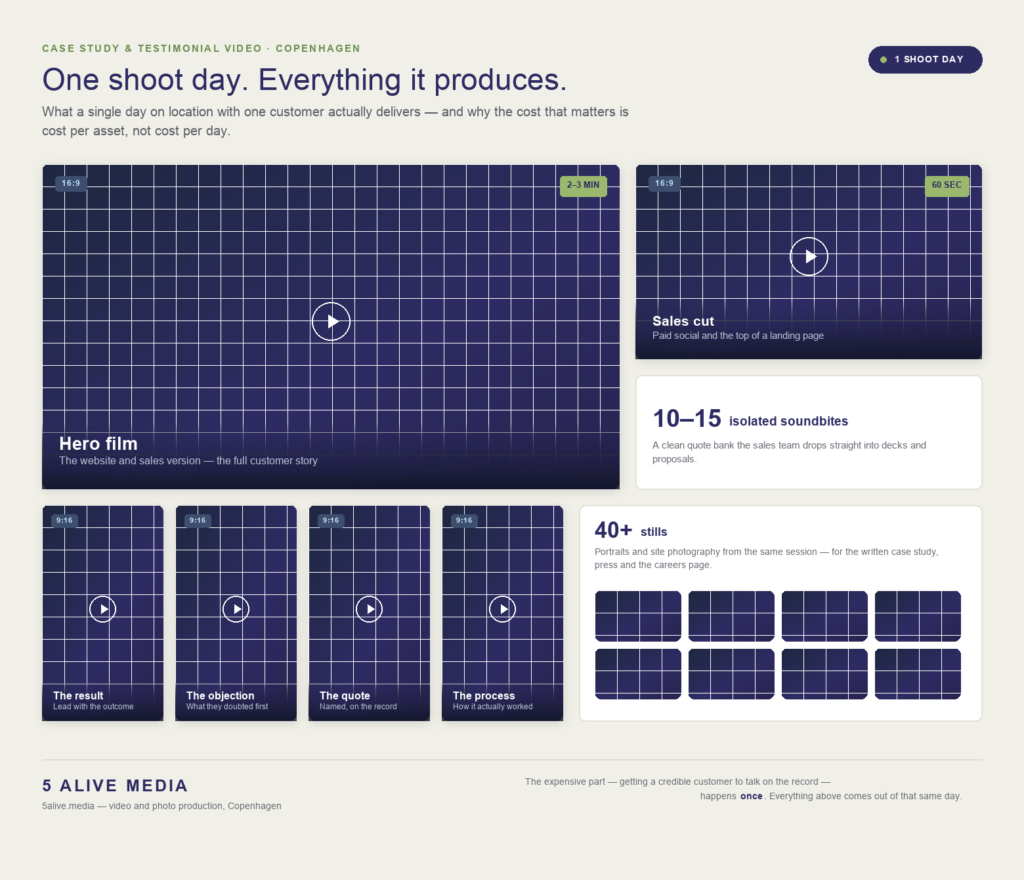
A single well-planned case study shoot day — one customer, one location, interviews plus supporting footage of the work in context — produces:
- One hero film, 2–3 minutes — the website and sales version
- One 60-second cut — for paid social and the top of a landing page
- 4–6 vertical social edits — one strong claim each, captioned, built for LinkedIn
- A clean quote bank — isolated soundbites your sales team can drop into decks and proposals
- Stills from the same session — portraits and environment shots for the written case study, press and your careers page
Divide the day rate by that list and the per-asset number stops looking like a production cost and starts looking like what it is: the cheapest content you’ll produce all year, because the expensive part — getting a credible customer to sit down and talk on the record — only happens once.
One planning note that saves money: shoot the written case study and the film in the same session. The photography, the quotes and the footage all come from one visit, one scheduling negotiation, one hour of your client’s time. Commissioning them separately is how teams end up paying twice for the same access.
Brand films do a job a case study can’t
A case study film proves a specific claim. A brand film does something different — it tells people who you are at a moment when that changes. Rebrands, repositioning, a product launch, entering a new market, a founder-led company that has outgrown its original story.
The business case is straightforward: 93% of video marketers say video has increased brand awareness, 85% say it has generated leads and 83% say it has directly increased sales. But awareness is the honest primary outcome for a brand film, and it’s worth being clear about that rather than promising a pipeline number a positioning film was never designed to deliver.
Recent brand and launch work from our team in Copenhagen:
- Katalist x ZEM — brand and product film built around a repositioning
- Ramboll — customer case study film for a global engineering consultancy
- Connecteam x Museum of Illusions — customer story filmed on location at the client’s own site
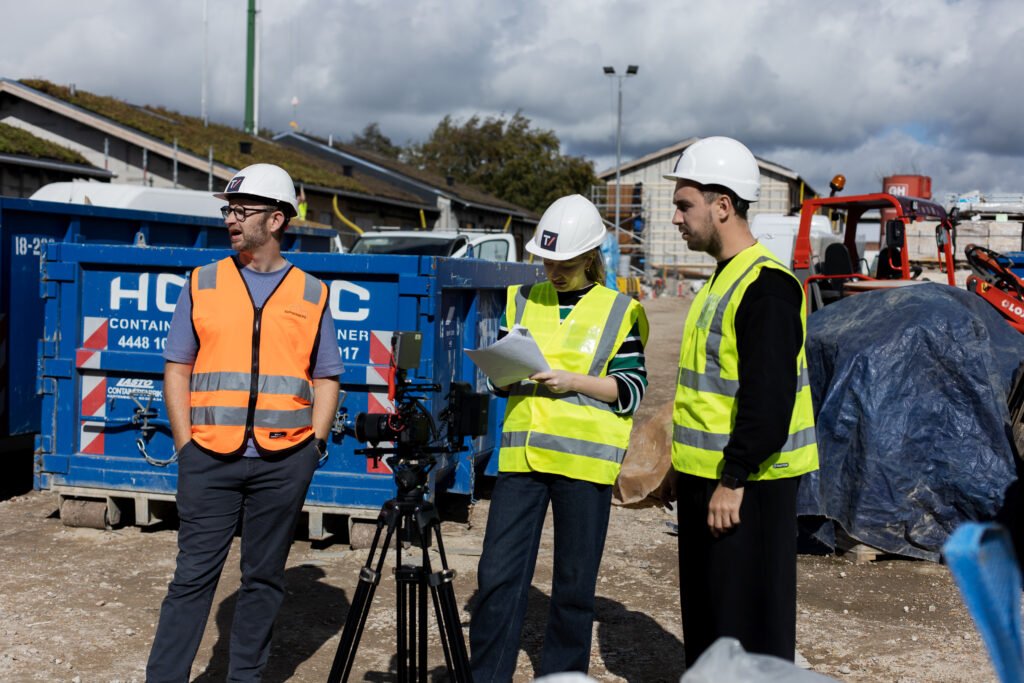
- Ocorian x Thylander — client success story filmed across development sites in Denmark
We mention these by name deliberately. It’s worth noticing how many production companies in this market display client logos for work they didn’t do, or can’t name a single project behind them. When you’re shortlisting, ask for the project, not the logo wall.
The same film helps you hire
This is the return almost nobody budgets for and most companies accidentally receive.
A customer story shows a candidate what the work actually is, who does it and what it’s like in the room — which no job advert manages. LinkedIn’s long-standing employer brand research put the effect of a strong employer brand at 28% lower staff turnover and up to 50% lower cost per hire. That study is now around a decade old, so treat it as a durable directional finding rather than a current benchmark — but the mechanism hasn’t changed, and the cost of a single senior hire in Copenhagen makes even a fraction of that effect material.
Practically: when you brief a case study shoot, ask for a second edit cut for recruitment. It’s the same footage, a different edit, and a markedly cheaper way to get careers-page content than commissioning an employer brand film from scratch.
How to actually measure it
Here’s the problem with how most teams report on this. 67% of video marketers quantify ROI through video views — which tells you a video was served, and nothing about whether it moved a deal. If views are your headline metric, you’ll conclude a case study film underperformed a product clip, when the case study was watched by nine people and three of them signed.
Measure these instead:
- Deals influenced — add one field to your CRM: was a case study film shared in this deal? Review it quarterly against win rate
- Sales-team reuse — how many reps put it in a deck without being asked. The most honest quality signal you’ll get
- Conversion on the page it lives on — compare the case study page with and without the film, not the video in isolation
- Completion rate, not view count — a 70% completion on 400 views beats 12% on 9,000
- Applicants per role — if you’re using a cut for recruitment, track it before and after
One format note worth briefing in: 71% of people consider videos between 30 seconds and two minutes most effective. If the hero cut is running past three and a half minutes, it’s usually because nobody was willing to cut a stakeholder’s favourite line.
What clients who rebook tell us
The most useful signal in this industry isn’t a showreel. It’s who books a second time, and a third.
Google has worked with our team across multiple years of Nordic events, from Slush to TechBBQ to recurring executive dinners. Veeva Systems brings us back for summit coverage across editions and across markets. Vibia returned for 3daysofdesign in Copenhagen in both 2024 and 2026. Journey Ops has run multi-city productions with us across Malmö, Stockholm and Helsinki.
Nobody rebooks a production company because the last film was pleasant to make. They rebook because the content did something — and because the second shoot is easier than the first, since the crew already knows the brand, the stakeholders and what the edit needs to achieve.
Next step
Planning a case study, testimonial or brand film?
Tell us the customer story you want to tell and we’ll send a free content plan — exactly what one shoot day would produce for you, and what each asset is for.
Frequently asked questions
How much does a case study or testimonial video cost in Copenhagen?
A single-customer case study film with one interview and supporting footage typically runs from around DKK 18,000–35,000, depending on crew size, number of locations, how many edit versions you need and whether stills are included. What moves the number most is locations and deliverables, not shoot hours — adding a second site usually costs more than adding a second interview at the same site. Send us the brief and we’ll quote against your actual deliverable list.
How long does a case study video take to produce?
Standard delivery is 3–7 business days from the shoot for the hero film and social cuts. Larger multi-deliverable productions — several customers, multiple locations or a recruitment cut alongside the sales version — run 7–14 days. The longest variable is never editing; it’s client-side approval, so agree who signs off before the shoot rather than after.
Do we need a written case study as well as the video?
Yes, and they should come from the same session. The written version does the SEO work and gets found in search; the film does the persuasion work and gets forwarded inside the buying group. They answer different needs, and producing both from one visit costs far less than commissioning them separately.
What if our client won’t agree to be filmed?
It’s more common than you’d think, and usually a process problem rather than a refusal. Ask early, while the result is fresh and the relationship is warm; keep the time commitment to 90 minutes on their own site; offer them the footage for their own channels; and send questions in advance so nobody feels ambushed. If a named customer genuinely can’t appear, an anonymised film built around the work itself with a voiced narrative still beats no story at all.
A case study film is the only marketing asset where someone else makes your argument for you. That’s not a production upgrade on a written case study — it’s a different instrument, and it works in rooms you’ll never be in.
5 ALIVE MEDIA is a Copenhagen-based video and photo production company producing brand films, customer case studies and event content across Denmark and the Nordics. Clients include Google, Mastercard, Ramboll, Honda, Visit Denmark and TED, alongside 100+ brands.

Roland Varsbergs
Rolands Varsbergs is the founder and Creative Director of 5 ALIVE MEDIA — a Copenhagen-based video production and photography agency. With 8+ years of production experience, he has directed and produced commercial films, event coverage and brand content for Google, Honda, Visit Denmark, TED and 100+ brands across Denmark and internationally. A certified drone pilot and Director of Photography, Rolands leads productions ranging from single-day corporate shoots to multi-day international events and studio commercial films.
Leave a Reply