


Filming in Copenhagen: Permits, Costs & Light
Here is the thing almost no guide to filming in Copenhagen mentions: you cannot apply for a filming permit here without a Danish digital ID and a Danish company registration number.
Not “it helps to have one.” You cannot submit the application. The city’s portal requires MitID to log in, and the form asks for your CVR and P-number. If you are a production company in London, Berlin or New York planning a shoot on a Copenhagen street, that single requirement decides how your production is structured before you have thought about a single shot.
This is a practical guide to what filming in Copenhagen actually involves — permits, timelines, costs, locations, drones, and the one variable that catches out more foreign productions than anything else: the light.
Do you need a filming permit in Copenhagen?
For outdoor filming on public road areas, yes. Københavns Kommune requires permission for filming on streets, pavements and squares, and that covers most of what people picture when they imagine shooting in Copenhagen.
Three things trip people up:
- One application per location. A three-location day is three separate applications, each with its own processing time.
- Parks are a different system. Fælledparken, Kongens Have, the harbour-side green areas and sports facilities are not road areas. They need a separate outdoor event application, and unlike road areas they can carry fees.
- A permit does not give you consent. It covers the use of public space. Filming identifiable private individuals or private property still needs their agreement, separately.
Private shared roads add another layer: the road authority has to consult the affected parties, and the police have to approve before a permit is issued.

The timelines that actually set your shoot date
This is where productions lose weeks. The published processing times:
- 10 working days for a straightforward road-area application
- Up to 20 working days if other parties have to be consulted
- Around 15 working days for private shared road consultation — longer if anyone objects
- About a week before the shoot, neighbouring residents should receive a letter telling them what is happening
- At least 24 hours before, parking restriction signs and stop-ban equipment must be physically in place
Add those up honestly. Twenty working days is four weeks. Then a week for neighbour notification, which overlaps but has to happen after approval. A multi-location commercial that needs to be in the can by a fixed campaign date should start permits six to eight weeks out, not two.
One detail worth knowing if your storyboard involves a quiet street: momentary traffic blocking is permitted, but only for three to four minutes at a time, and only police or trained personnel in safety vests may regulate traffic. That number shapes how you schedule a take.
What it costs
The permit itself is usually the cheapest part of the day. There is currently no application fee for road areas in Copenhagen. Parks, cemeteries and other green areas can charge, and private venues set their own location fees.
What actually moves a Copenhagen production budget:
- Number of locations — more than company moves, it is the permit admin and the travel time between them
- Crew size — a one-operator interview day and a five-person commercial crew are different productions
- Deliverables — a hero film plus six social cutdowns plus subtitled versions is where post-production hours live
- Time of year — see below, because in winter it decides how many hours you can actually shoot
The light: the variable foreign productions underestimate
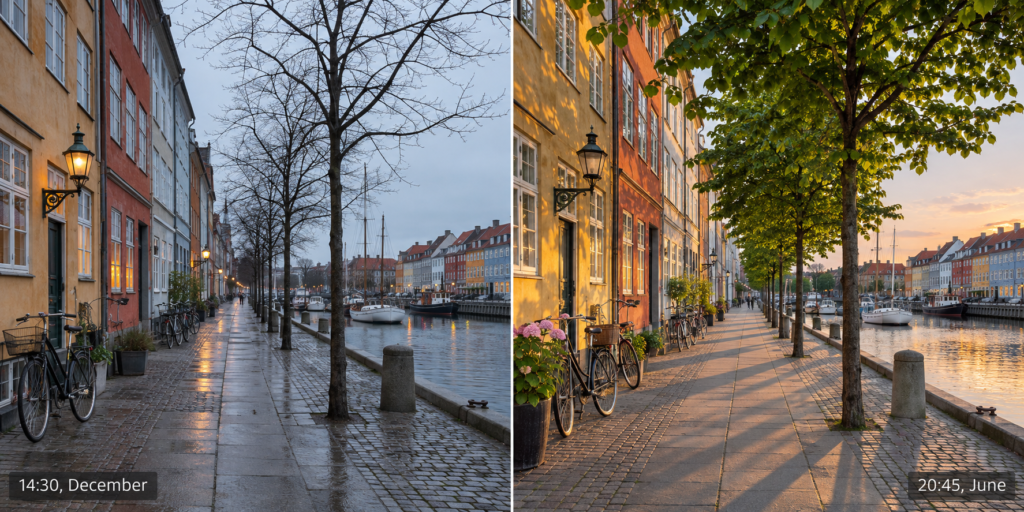
Copenhagen sits at roughly 55.7° north. That is further north than Moscow. It produces the best natural light in Europe for about four months of the year and the hardest for about three, and no guide written from abroad seems to mention it.
Mid-December: roughly seven hours of daylight. Sunrise around 08:35, sunset around 15:40. Factor in overcast skies and you have perhaps five usable hours of exterior light, and golden hour arrives in the middle of the working afternoon. A full exterior day in December is not a full day.
Mid-June: roughly 17.5 hours. Sunrise around 04:25, sunset around 21:55, with usable twilight either side. Golden hour stretches for well over an hour at each end. You can film a sunrise harbour sequence and a sunset rooftop on the same day without rushing.
The practical consequences:
- November to January: schedule exteriors first and interviews after dark. Budget for lighting on everything, including what you assumed would be daylight.
- February to April: workable, changeable. Build a weather contingency into the schedule rather than hoping.
- May to August: the window. Long days, soft light, and the city visibly in a better mood — which shows on camera more than people expect.
- September to October: arguably the best light of the year. Low sun, long shadows, autumn colour, and fewer tourists in frame.
Wind matters too. Harbour locations — Nyhavn, Islands Brygge, Refshaleøen — are exposed, and a steady Danish wind will ruin audio long before it troubles the camera. Plan for wired or well-shielded sound at the water.
Locations that work, and what to know about each
Harbour and waterfront
Nyhavn is the postcard, and it is busy from mid-morning until late. If you want it without crowds you are filming before 07:00. Islands Brygge, Refshaleøen and the Nordhavn waterfront give you the same water-and-sky quality with far more control, and Refshaleøen in particular has the post-industrial texture that suits brand work.
Historic streets
The old city around Gråbrødretorv, Magstræde and Snaregade gives you cobbles and colour. These are narrow streets with residents, which means the neighbour notification step is not a formality, and loading in means a short carry from wherever the van can legally stop.
Modern and corporate
Ørestad, Nordhavn and Carlsberg Byen offer contemporary architecture and glass. Much of it is privately owned despite looking public, so confirm who actually controls the ground you intend to put a tripod on.
Conference and event venues
Bella Center, Tivoli Hotel & Congress Center, DGI Byen, Scandic Spectrum and Villa Copenhagen handle most of the city’s business events. Each has its own AV protocol, its own rules about where crew can stand during a keynote, and its own view on whether you can tap the house sound desk. Those conversations happen with the venue, not the city.
Studios
Copenhagen has a decent spread of hire studios, and for interviews and controlled brand work a studio removes the permit question entirely. We work with partner studios across the city, and for interview and podcast work we also bring a pop-up studio to the client’s own office — which is often the better option when the people you need on camera are already in the building.

Drones in Copenhagen
Aerial footage of Copenhagen is achievable and it is not casual. Two separate things have to line up.
First, national aviation rules. Denmark operates under the EU drone framework, which means registration, the right operator certification for the category of flight, and compliance with the geo-zones published at droneregler.dk. Copenhagen Airport sits close to the city, and its control zone reaches further over the urban area than most visitors assume.
Second, the city. Drone filming requires a separate municipal permit on top of your aviation compliance. A road filming permit does not cover it.
In practice, aerial work in central Copenhagen is planned weeks ahead, not added to a shoot day as an afterthought. Our crew holds EU drone certification and handles both the aviation side and the city permit as part of production planning.

Bringing a crew in, or hiring locally
Back to MitID. A foreign production company cannot submit a Copenhagen road filming permit application on its own: the portal requires Danish digital identification, the form requires a CVR and P-number, and most of the supporting documentation is in Danish only.
That leaves three routes. Film only in private venues and studios and avoid the public realm entirely. Appoint a Danish production partner to hold the permits. Or shoot without one and accept the risk — which, given that permits can be revoked on site and the applicant is liable for restoring the area, is not a serious option for a commercial production.
For most international clients the practical answer is a local crew who already hold the registrations, know which case officer handles which district, and have done the walk-through at the venue before. That is most of what a local partner is actually for — the camera work is the part everyone can do.
A realistic timeline
For a multi-location brand film shot on Copenhagen streets:
- 8 weeks out — lock locations, start permit applications
- 6 weeks out — confirm venues, book crew, plan drone if needed
- 4 weeks out — permits should be landing; recce the locations
- 1 week out — neighbour letters out, signage ordered, call sheets issued
- 24 hours out — parking signs and stop-ban equipment physically placed
A single-location interview or an event inside a venue needs none of this and can be arranged in days. The admin scales with how much public space you occupy, not with how good the film is.
Frequently asked questions
Do I need a permit to film in Copenhagen?
For outdoor filming on public road areas, yes — one application per location, through Københavns Kommune. Parks and green areas need a separate outdoor event application. Filming inside a private venue or hire studio needs the owner’s permission rather than a city permit.
How long does a Copenhagen filming permit take?
Around 10 working days for a straightforward road-area application, and up to 20 if other parties must be consulted. Private shared roads add roughly 15 working days of consultation. Plan six to eight weeks for anything involving several public locations.
Can a foreign production company apply for the permit itself?
Not directly. The application portal requires MitID, Denmark’s digital identification, and the form requires a Danish CVR and P-number. Foreign productions either work through a Danish production partner, or confine the shoot to private venues and studios.
How much does a filming permit cost in Copenhagen?
There is currently no application fee for road areas. Parks, cemeteries and other green areas can charge, and private venues set their own location fees. The permit is rarely the significant cost — crew, equipment and post-production are.
When is the best time of year to film in Copenhagen?
May to September for daylight hours, and September to October for the best quality of light. December gives you around seven hours of daylight, so winter exteriors need a compressed schedule and more lighting than people budget for.
Can you fly a drone over central Copenhagen?
With the right certification and permissions, in the right places. You need to comply with Danish and EU aviation rules including the geo-zones around Copenhagen Airport, and you need a separate municipal permit for drone filming. It is planned weeks ahead rather than decided on the day.
Planning a shoot in Copenhagen?
We are a Copenhagen production company working with international brands, agencies and production companies who need a local crew that already holds the registrations and knows the city. Tell us the dates and the locations and we will tell you what is realistic.
Official sources: Københavns Kommune — film recordings · Danish drone regulations
Related: Video production in Copenhagen · Event videography · Drone filming in Copenhagen

Roland Varsbergs
Rolands Varsbergs is the founder and Creative Director of 5 ALIVE MEDIA — a Copenhagen-based video production and photography agency. With 8+ years of production experience, he has directed and produced commercial films, event coverage and brand content for Google, Honda, Visit Denmark, TED and 100+ brands across Denmark and internationally. A certified drone pilot and Director of Photography, Rolands leads productions ranging from single-day corporate shoots to multi-day international events and studio commercial films.
Leave a Reply