

The Enterprise Corporate Video Workflow in 2026 – From Strategy to Distribution
They’re asking how to do it in a way that supports real business goals – not just awareness, not just aesthetics, and not just a single campaign moment.The difference between corporate video that performs and corporate video that disappears is rarely the camera.
It’s planning, intent, and how the content is used long after filming ends.At 5 ALIVE MEDIA, we work with brands across technology, professional services, hospitality, and global events.
From Copenhagen to Cyprus and across Europe, we’ve seen how the strongest corporate videos in 2026 are built – from the first conversation to distribution months later.This article breaks down how enterprise corporate videos are actually planned, filmed, and used today – and why this approach consistently delivers better results.
Key takeaways
- Enterprise video is won in pre-production
- One filming day should produce multiple assets
- Distribution planning is part of production
Step 1: Planning Starts With Usage, Not the Video Itself
The most common mistake we still see is starting with the question:
“What video do we want to make?”
Enterprise teams that get the best results start elsewhere:
“Where will this content live, and what should it achieve?”
In 2026, effective corporate video planning begins with clarity on:
- Primary audience (customers, partners, investors, internal teams)
- Primary channel (LinkedIn, website, sales decks, internal comms)
- Longevity (campaign-specific or evergreen)
- Secondary outputs (cutdowns, testimonials, social clips)
This shift changes everything.
A leadership film meant for a homepage has different pacing, framing, and tone than content designed for LinkedIn or internal onboarding.
When planning starts with usage, production becomes more efficient – and the final content performs better.
This is the same logic behind our
corporate video production guide for 2026,
where planning and distribution are treated as part of the same system.
Step 2: Pre-Production Is Where Enterprise Video Is Won or Lost
For enterprise brands, pre-production is not paperwork.
It’s risk management.
This is where alignment happens between stakeholders, messaging is clarified, and time on set is protected.
Strong pre-production typically includes:
- Clear messaging framework (what must be said, what should be avoided)
- Speaker preparation – especially for executives
- Location and lighting planning that reflects brand tone
- Shot lists designed for multiple outputs
- Contingency planning for time constraints
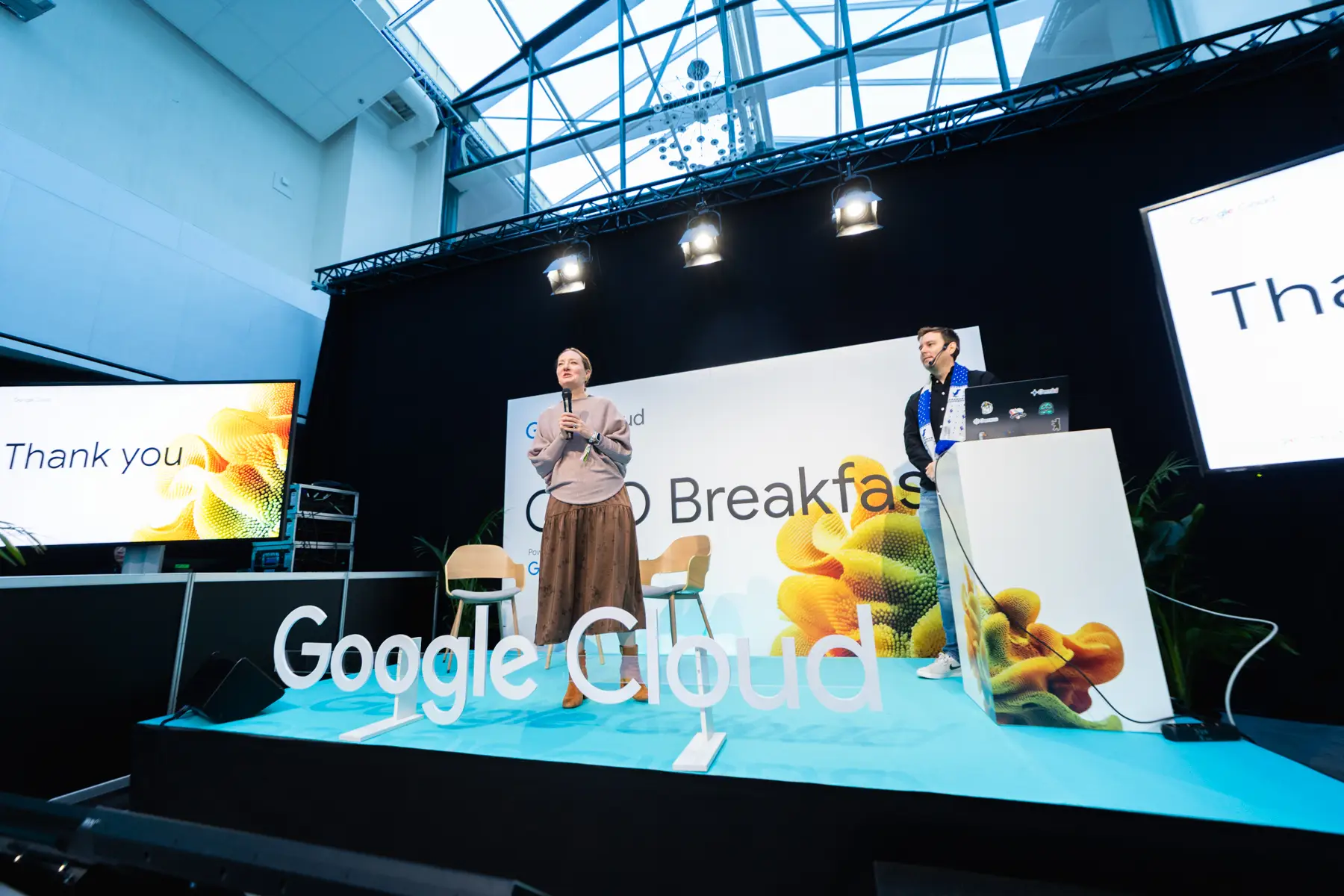
When we worked with Google at Slush,
this phase mattered as much as filming itself.
The environment was fast-moving, schedules changed, and access windows were tight.
Because planning was done with precision, we could adapt on site without compromising quality or tone.
This allowed us to capture usable leadership content and event footage without disrupting the flow of the conference.
The environment was fast-moving, schedules changed, and access windows were tight.
Because planning was done with precision, we could adapt on site without compromising quality or tone.
Enterprise video production doesn’t fail because of creativity.
It fails when planning underestimates reality.
Example: During our work with Google at Slush 2025, pre-production was critical. Tight speaker schedules, multiple stakeholders, and a live event environment meant every decision had to be planned before cameras rolled. This allowed us to capture usable leadership content and event footage without disrupting the flow of the conference.
Step 3: Filming Is About Creating Trust, Not Just Visuals
On set, enterprise video production is less about directing and more about awareness.
Executives are not performers.
Employees are not actors.
Customers are not trained speakers.
The role of a professional production team in 2026 is to create an environment where people feel comfortable enough to be real.
This requires:
- Calm, unobtrusive presence on set
- Clear communication without over-direction
- Respect for time and seniority
- Ability to read the room and adjust in real time
This human factor is still the strongest differentiator between content that feels authentic and content that feels staged.
It’s also why real production continues to matter, even as AI tools become more powerful.
Trust can’t be generated automatically.
Step 4: One Production Day, Multiple Strategic Outputs
In 2026, enterprise brands don’t invest in single-use videos.
They invest in production days that generate:
- A core corporate or leadership film
- Testimonial segments
- Short-form clips for LinkedIn
- Internal communication assets
- Visual libraries for future use
This approach reduces cost per asset and increases consistency across channels.
It also aligns closely with how modern teams consume content – in fragments, over time, across platforms.
This is where our work often overlaps with
practical shot planning
and
AI-assisted editing workflows,
allowing brands to scale outputs without losing coherence.
Step 5: Post-Production Is Where Strategy Becomes Visible
Post-production in 2026 is not just about editing.
It’s about decision-making.
This is where tone is refined, pacing is set, and hierarchy of messages becomes clear.
AI plays an important role here – accelerating edits, supporting transitions, and enabling faster versioning.
But it doesn’t replace editorial judgment.
The strongest corporate videos still rely on:
- Clear narrative structure
- Intentional pacing
- Selective restraint – knowing what not to include
- Alignment with brand voice
This balance between speed and intention is what allows enterprise brands to publish quickly without feeling rushed.
Step 6: Distribution Is Planned, Not Hoped For
A corporate video that isn’t distributed strategically is unfinished work.
In 2026, enterprise teams treat distribution as part of production – not an afterthought.
This includes:
- Native uploads for LinkedIn and social platforms
- Website placement with SEO considerations
- Sales and partnership usage
- Internal rollout for teams and leadership
Timing matters.
Publishing while attention is still present – especially after events or announcements – consistently outperforms delayed releases.
This is something we’ve seen repeatedly across conferences, launches, and corporate milestones.
Strong Opinion: Enterprise Video Is a System, Not a File
Here’s the reality in 2026:
Corporate video that works is rarely a single deliverable.
It’s a system of planning, production, and usage that supports business objectives over time.
Brands that treat video as a checkbox produce content that looks fine and performs poorly.
Brands that treat video as infrastructure build assets that compound in value.
This is why enterprise video production partners are no longer just vendors.
They’re collaborators who understand context, pressure, and long-term use.
Final Thoughts: Why This Approach Wins in 2026
The corporate videos that stand out in 2026 are not louder or more complex.
They are clearer.
They respect the audience’s time.
They feel grounded.
They serve multiple purposes without feeling diluted.
At 5 ALIVE MEDIA, this is how we approach every enterprise project –
from global events to leadership storytelling.
If you’re planning corporate video in 2026,
the most important question isn’t what camera to use.
It’s how the content will live, evolve, and continue to work once filming ends.
Leave a Reply