

How AI and Real Video Production Work Together in 2026
Some of it is impressive. Some of it is noise. Most of it raises the same question for corporate teams:Do we still need real video production?The short answer is yes. But not in the way it used to be.
In 2026, the strongest video work doesn’t sit on either extreme.
It’s not anti-AI, and it’s not fully automated.
The most effective brands are using AI and real video production together – each for what it does best.
At 5 ALIVE MEDIA, we work this way every day.
We use AI where it adds speed, flexibility, and creative leverage.
And we rely on real production where trust, authenticity, and human presence actually matter.
This article explains how those two worlds come together – and why corporations that understand the balance will stand out, while others blend into the feed.
The AI Hype Problem (And Why Corporations Are Feeling It)
AI video tools have lowered the barrier to entry.
Today, almost anyone can generate moving images, transitions, voiceovers, and even talking heads.
That’s not a bad thing – but it has a side effect.
When everything becomes possible, discernment becomes the differentiator.
For corporate brands, the risk isn’t that AI will replace video production.
The real risk is producing content that feels interchangeable.
Clean, fast, technically correct – but emotionally flat.
We’re already seeing it:
AI-generated videos that look “fine,” but leave no impression.
Explainers that say everything, yet feel empty.
Content that performs for a moment, then disappears.
Corporations don’t lose trust because they use AI.
They lose trust when their content stops feeling real.
What AI Is Actually Very Good At in Video Production
Let’s be clear: AI is not the enemy.
Used correctly, it’s one of the most powerful tools modern production teams have ever had.
In our workflow, AI excels at:
- Editing acceleration – speeding up rough cuts, selects, and variations
- Seamless transitions that would be time-consuming or impractical to build manually
- Versioning at scale for different platforms, formats, and markets
- Enhancing continuity across fast-paced event edits
- Reducing turnaround time without sacrificing consistency
A good example of this balance was our work with Google at Slush.
The production itself was fully real:
on-location filming, real people, real environments, real conversations.
But in post-production, AI-assisted editing allowed us to create
smooth narrative transitions and multiple content outputs quickly –
without anyone noticing where automation started or ended.
That’s the goal.
When AI is used well, it’s invisible.
When it’s used poorly, it becomes the story – and that’s rarely what brands want.
Where Real Video Production Still Matters (More Than Ever)
Despite all the tools available, there are parts of video production that AI simply cannot replace.
Not because the technology isn’t advanced – but because trust is not a technical problem.
Real production matters most when:
- Executives speak on camera
- Customers share testimonials
- Employees represent the culture of a company
- Brands show up at major events or industry moments
- Presence, credibility, and tone matter more than speed
These moments require more than visuals.
They require judgment, timing, and human awareness.
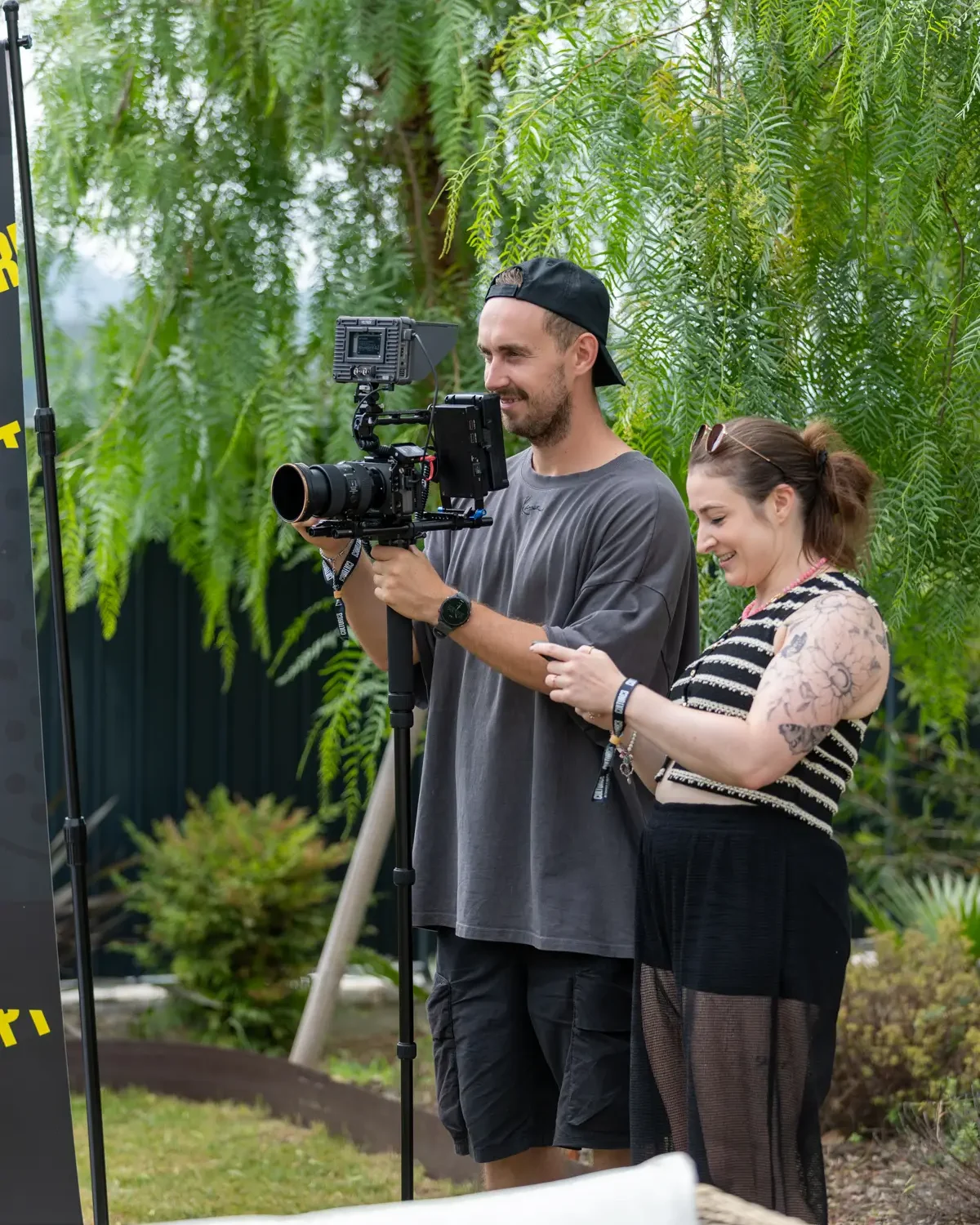
A camera on set isn’t just recording images.
It’s reading the room.
Knowing when to step closer, when to pull back, and when not to interrupt.
Understanding how to make people feel comfortable enough to be themselves.
No prompt replaces that.
Why Corporate Brands Can’t Rely on AI Alone
AI-generated video works best when the content is abstract.
But most corporate communication is not abstract.
It’s specific.
It’s contextual.
It’s tied to reputation.
When a brand speaks about leadership, culture, responsibility, or vision,
the audience is not just evaluating the message –
they’re evaluating whether it feels believable.
This is why corporate video production still depends on real people behind the camera.
Not to fight AI, but to guide it.
We see the most effective brands treat AI as a multiplier, not a replacement.
The thinking comes first.
The production grounds the story in reality.
AI helps scale and refine the output.
How AI and Real Production Actually Work Together in Practice
In 2026, the most effective workflow looks like this:
- Real production defines the truth – people, environments, moments
- Human storytelling sets the narrative
- AI supports speed, consistency, and scale
For example:
- An executive interview filmed in Copenhagen becomes the anchor
- AI-assisted editing generates multiple versions for LinkedIn, website, and internal use
- Subtle AI transitions improve pacing without changing the message
- Distribution-ready formats are delivered quickly, while relevance is still high
This approach is especially powerful for:
It’s not about choosing sides.
It’s about choosing outcomes.
The Strongest Opinion We Hold on AI and Video
Here’s the honest take:
AI will not replace real video production.
But it will expose weak production faster than ever.
When everyone has access to the same tools,
what matters is not what you generate –
but what you choose to show.
Brands that rely solely on AI will move faster,
but they will also sound the same.
Brands that combine real production with intelligent use of AI
will move fast and remain distinctive.
That distinction is where long-term value lives.
Final Thoughts: The Future Isn’t AI or Human – It’s Intentional
In 2026, standing out isn’t about rejecting new technology.
It’s about knowing when to use it – and when not to.
AI helps us work smarter.
Real video production helps brands stay believable.
At 5 ALIVE MEDIA, we combine both.
We use AI where it improves speed and execution,
and we rely on real production where trust, nuance, and presence matter.
If you’re planning corporate or event video in 2026,
the question isn’t whether to use AI.
It’s whether your content still feels human once you do.
Let’s talk about what that balance looks like for your brand →

Roland Varsbergs
Rolands Varsbergs is the founder and Creative Director of 5 ALIVE MEDIA — a Copenhagen-based video production and photography agency. With 8+ years of production experience, he has directed and produced commercial films, event coverage and brand content for Google, Honda, Visit Denmark, TED and 100+ brands across Denmark and internationally. A certified drone pilot and Director of Photography, Rolands leads productions ranging from single-day corporate shoots to multi-day international events and studio commercial films.
Leave a Reply